+91 9618692266

-
-
Working Hours
Mon - Fri: 9 am to 6 pm
-
SBR Gateway, HITEC City
Hyderabad, 500081
08
Aug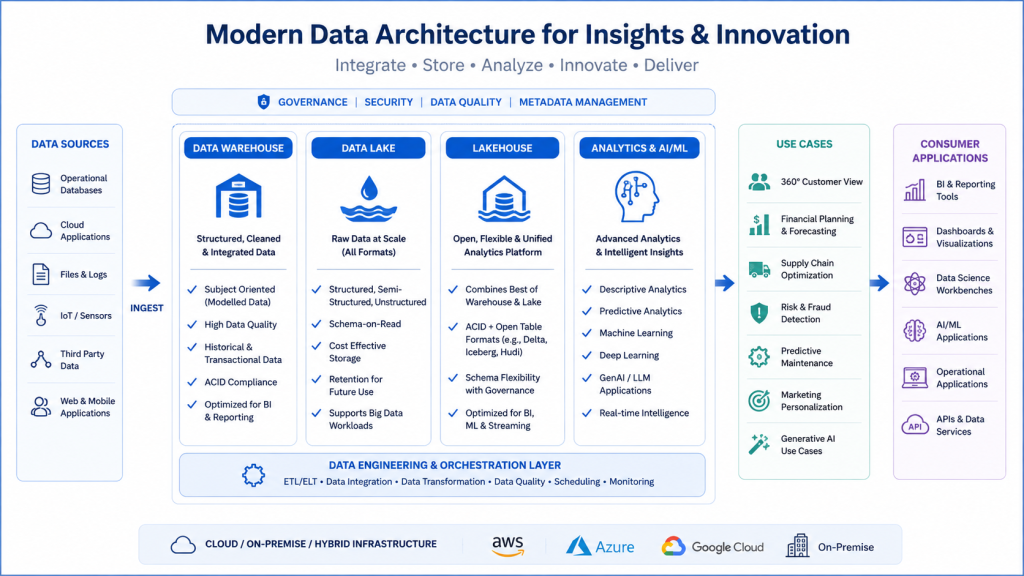
Introduction
Every organization generates data.
A bank generates data when you deposit money or make a payment.
An e-commerce company generates data when you browse a product, place an order, or return an item.
A hospital generates data when a patient registers, meets a doctor, gets a test, or receives a bill.
A manufacturing company generates data from machines, production lines, inventory, suppliers, and quality systems.
But here is the interesting part:
Having lots of data does not automatically mean having useful information.
Data is often scattered across many applications, databases, files, cloud systems, and devices.
The real challenge is:
How do we collect all this data, organize it, understand it, and turn it into useful information for business decisions?
This is where concepts such as Source Systems, Data Warehouses, Data Lakes, and Lakehouses come into the picture.
Let’s understand them in very simple language.
🏪 1. What Is a Source System?
A source system is simply the system where data is originally created or captured.
Think of a source system as the place where the data is born.
For example:
| Business | Source System | Example Data |
|---|---|---|
| 🏦 Bank | Core Banking System | Accounts, transactions, customers |
| 🛒 E-commerce | Order Management System | Orders, products, payments |
| 🏥 Hospital | Hospital Management System | Patients, doctors, appointments |
| 🏭 Manufacturing | ERP/MES | Production, inventory, machines |
| 👨💼 HR | HR System | Employees, salary, attendance |
| 📱 Mobile App | Application Database | Users, clicks, sessions |
A source system is usually designed to run the business, not necessarily to perform complex analytics.
Simple analogy
Imagine a supermarket.
The billing counter records every purchase.
It needs to answer questions such as:
“What did this customer buy?”
“How much should the customer pay?”
It is designed for fast transactions.
But the supermarket manager may ask:
“Which products sold the most during the last three years?”
“Which customer segment spends the most?”
“Which stores are performing better?”
The billing system may not be the best place to answer these questions.
That’s where analytical platforms become important.
⚡ 2. Why Do We Need Something Beyond Source Systems?
There are several reasons.
1️⃣ Operational systems are designed for transactions
Source systems need to process thousands or millions of transactions quickly.
For example:
Customer places order → Order is recorded → Payment is processed → Inventory is updated
This is called OLTP – Online Transaction Processing.
2️⃣ Analytics requires a different approach
Management may want to analyze:
- Sales trends
- Customer behavior
- Profitability
- Product performance
- Regional performance
- Year-over-year growth
- Forecasts
- Customer churn
- Fraud patterns
These are analytical questions.
Running large analytical queries directly against operational systems can affect the performance of the applications running the business.
3️⃣ Data is usually scattered
An organization might have:
CRM
 │
 ├── Customer Data
 │
ERP
 │
 ├── Finance
 ├── Inventory
 └── Procurement
 │
HR System
 │
 ├── Employee Data
 │
Web Application
 │
 └── Customer Activity
 │
IoT Devices
 │
 └── Machine Data
Now imagine trying to answer:
“Which customers generated the highest profit, and what products did they purchase?”
The required information may exist in five different systems.
We therefore need a platform that can bring the information together.
🏢 3. What Is a Data Warehouse?
A Data Warehouse (DWH) is a centralized place where business data from different systems is collected, cleaned, integrated, organized, and prepared for reporting and analytics.
Think of it as the organization’s central library of trusted business information.
Instead of asking:
“Where is the data?”
you can ask:
“What does the data tell us?”
Simple architecture
SOURCE SYSTEMS
🏦 Bank 🛒 Sales
│ │
├───────────┤
│ │
🏥 Hospital 👨💼 HR
│ │
└─────┬─────┘
↓
🔄 ETL / ELT
↓
🏢 DATA WAREHOUSE
↓
📊 BI / REPORTING
↓
👨💼 Business Users🧹 4. What Happens Inside a Data Warehouse?
Data normally goes through several steps.
Step 1 – Extract 📥
Data is collected from source systems.
For example:
- Customer database
- ERP
- CRM
- Excel files
- APIs
- Cloud applications
Step 2 – Transform 🔄
The data is cleaned and standardized.
For example:
One system may store:
USAAnother:
United StatesAnother:
USThe warehouse may standardize all three to:
United StatesStep 3 – Load 📦
The processed data is loaded into the Data Warehouse.
This process is traditionally called:
ETL – Extract, Transform, Load
Modern platforms also commonly use:
ELT – Extract, Load, Transform
📐 5. Important Characteristics of a Data Warehouse
A traditional data warehouse is commonly described using four important characteristics.
🎯 1. Subject-Oriented
Data is organized around important business subjects.
Examples:
- Customer
- Product
- Sales
- Finance
- Employee
Instead of focusing on individual applications, the warehouse focuses on business information.
🔗 2. Integrated
Data from different systems is brought together and standardized.
For example:
CRM → Customer
ERP → Customer
Mobile App → Customer
The warehouse attempts to create a consistent view of the customer.
🕒 3. Time-Variant
A data warehouse usually maintains historical information.
For example:
Sales – 2023
Sales – 2024
Sales – 2025
Sales – 2026
This allows businesses to understand trends over time.
🔒 4. Non-Volatile
Once data is loaded into the warehouse, it is generally not constantly changed like an operational database.
The warehouse is primarily designed for reading and analyzing data.
🧩 6. Data Warehouse Methodologies
There are several approaches to designing a data warehouse.
Three commonly discussed approaches are:
🏗️ Kimball Approach
The Kimball approach focuses heavily on business processes and dimensional models.
For example:
              Sales
                │
        ┌───────┼───────┐
        ↓       ↓       ↓
     Customer Product  Date
It commonly uses:
- Fact tables
- Dimension tables
- Star schemas
- Business-focused data marts
Best suited for
Organizations that want to deliver business reporting and analytics incrementally.
Simple analogy
Think of building a shopping mall one store at a time.
You can start with:
Sales → Finance → Inventory → Customer Analytics
🏛️ Inmon Approach
The Inmon approach generally starts with building a central enterprise data warehouse and then creating data marts for specific business areas.
              Enterprise
             Data Warehouse
                    │
        ┌───────────┼───────────┐
        ↓           ↓           ↓
      Sales       Finance       HR
      Mart         Mart         Mart
Simple analogy
Instead of building individual shops first, you first build the entire shopping complex, and then create individual stores inside it.
🛡️ Data Vault
Data Vault is another approach designed particularly for environments where data sources change frequently and organizations need strong historical tracking and flexibility.
It commonly uses concepts such as:
- Hubs
- Links
- Satellites
Simple analogy
Imagine maintaining a detailed historical diary of every important business entity and every relationship between them.
Data Vault is especially useful when organizations have:
- Many data sources
- Frequently changing requirements
- Strong historical tracking requirements
- Complex enterprise data environments
📊 7. Advantages of a Data Warehouse
✅ Better reporting
Business users can get consistent reports.
✅ Single source of truth
Different departments can work from standardized information.
✅ Historical analysis
Organizations can analyze trends over months or years.
✅ Better performance for analytics
The warehouse is designed for analytical workloads.
✅ Improved data quality
Data can be cleaned, standardized, validated, and governed.
✅ Business intelligence
It becomes easier to build:
- Dashboards
- Reports
- KPIs
- Management scorecards
- Analytical models
⚠️ 8. Disadvantages of Traditional Data Warehouses
Data warehouses are powerful, but they aren’t perfect.
❌ Can be expensive
Infrastructure, licenses, development, and maintenance can become costly.
❌ Data modeling takes time
Traditional warehouse projects often require significant upfront design.
❌ Less flexible for unstructured data
Traditional warehouses are primarily optimized for structured business data.
❌ Changes can take time
When business requirements or source systems change significantly, warehouse structures may need modification.
❌ Large-scale data can become challenging
Storing massive volumes of logs, images, videos, IoT data, and semi-structured information may not be the most economical approach.
And this brings us to the next evolution.
🌊 9. What Is a Data Lake?
A Data Lake is a large storage environment where organizations can store enormous amounts of data in its original or near-original form.
Think of a data lake as a giant warehouse where you can put almost anything.
You don’t necessarily need to organize everything before storing it.
You can store:
📄 Documents
📊 CSV files
🗃️ Database data
📝 JSON
📷 Images
🎥 Videos
🎧 Audio
📡 IoT data
📋 Application logs
🤖 Machine learning datasets
🏞️ Data Lake Analogy
Imagine a lake.
Water from many rivers flows into the lake.
Similarly:
CRM ─────────┐
ERP ─────────┤
Web ─────────┤
Mobile ──────┤
IoT ─────────┤
Files ───────┤
Logs ────────┘
       ↓
   🌊 DATA LAKE
The data can be stored first and analyzed later.
This concept is sometimes called:
Schema-on-Read
In simple terms:
Store first → Understand/use it when needed.
🗂️ 10. Typical Data Lake Layers
A data lake commonly has different zones.
🥉 Bronze / Raw
Data is stored largely in its original form.
Raw CRM data
Raw ERP data
Raw IoT data
Raw log data
🥈 Silver / Refined
Data is cleaned, standardized, and integrated.
🥇 Gold / Curated
Data is transformed into business-ready datasets.
RAW
 ↓
BRONZE
 ↓
SILVER
 ↓
GOLD
 ↓
Analytics / BI / AI
The exact naming can vary by organization and platform.
🚀 11. Why Do We Need a Data Lake?
Modern organizations generate enormous amounts of data.
Traditional business systems may only contain structured tables.
But today’s organizations also generate:
- Machine logs
- Clickstreams
- Social media data
- Images
- Videos
- Sensor data
- JSON
- Application logs
- Documents
- AI training data
A data lake provides a flexible and scalable place to store these different types of data.
🧬 12. Important Characteristics of Data Lakes
📦 Massive scale
Can handle very large volumes of data.
🌀 Variety
Can store structured, semi-structured, and unstructured data.
⚡ Flexible
Data doesn’t always need to be fully modeled before storage.
💰 Cost-effective storage
Cloud object storage can provide economical large-scale storage.
🤖 AI/ML friendly
Data scientists can access raw and detailed datasets for machine learning and experimentation.
✅ 13. Advantages of a Data Lake
1. Store almost anything
Structured + semi-structured + unstructured data.
2. Highly scalable
Suitable for very large datasets.
3. Flexible
New data sources can often be added without redesigning the entire platform.
4. Useful for AI/ML
Data scientists can work with raw and detailed data.
5. Cost-effective storage
Cloud-based object storage can be economical for large volumes.
⚠️ 14. Disadvantages of a Data Lake
A data lake can become a problem if it isn’t managed properly.
🗑️ Data swamp
If data is dumped into the lake without governance, it can become difficult to find or trust anything.
Imagine a lake where everyone throws things in but nobody labels them.
You have lots of data—but nobody knows:
“What is this?”
“Who owns it?”
“Can I trust it?”
“When was it created?”
“Which version should I use?”
This is commonly described as a Data Swamp.
❌ Data quality issues
Raw data may contain duplicates, missing values, errors, or inconsistent formats.
❌ Governance challenges
Security, privacy, ownership, lineage, and access need careful management.
❌ Analytical complexity
Business users may find raw data difficult to consume directly.
🏠 15. So What Is a Lakehouse?
Now we have two worlds:
🏢 Data Warehouse
Excellent for:
- Structured data
- BI
- Reporting
- Governance
- Business analytics
🌊 Data Lake
Excellent for:
- Massive data
- Raw data
- Unstructured data
- Data science
- AI/ML
- Flexible storage
The Lakehouse concept attempts to bring many of these advantages together.
Think of it as:
The flexibility of a Data Lake + the management and analytical capabilities of a Data Warehouse
🏠 Lakehouse Analogy
Imagine a modern house.
You don’t want:
A warehouse where everything is thrown randomly.
You also don’t want:
A tiny room where only a few types of things can fit.
You want:
A large, organized home where different things can be stored and used efficiently.
That’s the basic idea behind a lakehouse.
             DATA SOURCES
                  │
     ┌────────────┼────────────┐
     ↓            ↓            ↓
   ERP           CRM          IoT
     │            │            │
     └────────────┼────────────┘
                  ↓
          🏠 DATA LAKEHOUSE
                  │
       ┌──────────┼──────────┐
       ↓          ↓          ↓
      BI         AI/ML      Analytics
       ↓          ↓          ↓
    Reports   ML Models   Applications
🧱 16. What Does a Lakehouse Need?
A modern lakehouse typically needs several important capabilities.
💾 1. Scalable Storage
Usually cloud object storage or equivalent scalable storage.
Examples include:
- Data lake storage
- Object storage
- Distributed storage
📋 2. Data Management
The platform needs to organize datasets and tables.
🔐 3. Security
Organizations need:
- Authentication
- Authorization
- Role-based access
- Data masking
- Encryption
- Privacy controls
🧭 4. Data Governance
Users need to understand:
What is this data?
Who owns it?
Where did it come from?
Can I use it?
How sensitive is it?
🔍 5. Metadata and Catalog
A catalog helps users discover datasets.
Instead of searching through thousands of files, users can search:
Customer Sales Dataset
and understand:
- Description
- Owner
- Source
- Quality
- Lineage
- Security classification
🔄 6. Data Processing
The platform needs capabilities to:
- Ingest data
- Transform data
- Clean data
- Join datasets
- Aggregate data
📊 7. Analytics
Business users need tools to create:
- Reports
- Dashboards
- KPIs
- Ad-hoc analysis
🤖 8. AI/ML
Modern platforms increasingly need to support:
- Machine learning
- Generative AI
- Feature engineering
- Model training
- Model deployment
- AI-powered analytics
🧬 17. Data Characteristics: What Makes Data Different?
Before choosing a platform, organizations should understand the characteristics of their data.
A useful way to think about data is using the 5 Vs.
📦 Volume
How much data do we have?
GB → TB → PB → EB⚡ Velocity
How quickly is data generated?
For example:
A bank may generate millions of transactions every day.
An IoT system may generate sensor readings every second.
🌈 Variety
What types of data do we have?
Structured
Semi-structured
Unstructured
Examples:
Structured: SQL tables
Semi-structured: JSON, XML
Unstructured: Images, video, documents
🎯 Veracity
Can we trust the data?
For example:
Customer Age = 35
Customer Age = -10
Customer Age = ABC
Clearly, something is wrong with the second and third values.
💰 Value
Does the data actually provide business value?
Having petabytes of data isn’t useful if nobody can use it to make decisions.
🆚 18. Data Warehouse vs Data Lake vs Lakehouse
| Capability | 🏢 Data Warehouse | 🌊 Data Lake | 🏠 Lakehouse |
| Structured data | ⭐⭐⭐⭐⭐ | ⭐⭐⭐⭐ | ⭐⭐⭐⭐⭐ |
| Semi-structured data | ⭐⭐⭐ | ⭐⭐⭐⭐⭐ | ⭐⭐⭐⭐⭐ |
| Unstructured data | ⭐⭐ | ⭐⭐⭐⭐⭐ | ⭐⭐⭐⭐ |
| BI & Reporting | ⭐⭐⭐⭐⭐ | ⭐⭐⭐ | ⭐⭐⭐⭐⭐ |
| AI/ML | ⭐⭐⭐ | ⭐⭐⭐⭐⭐ | ⭐⭐⭐⭐⭐ |
| Flexibility | ⭐⭐⭐ | ⭐⭐⭐⭐⭐ | ⭐⭐⭐⭐⭐ |
| Governance | ⭐⭐⭐⭐⭐ | ⭐⭐⭐ | ⭐⭐⭐⭐⭐ |
| Historical analysis | ⭐⭐⭐⭐⭐ | ⭐⭐⭐⭐ | ⭐⭐⭐⭐⭐ |
| Scalability | ⭐⭐⭐⭐ | ⭐⭐⭐⭐⭐ | ⭐⭐⭐⭐⭐ |
The exact capabilities depend on the technology and implementation, but this table provides a simple conceptual comparison.
🔄 19. How the Architecture Has Evolved
The journey can be understood like this:
SOURCE SYSTEMS
      ↓
DATA WAREHOUSE
      ↓
DATA LAKE
      ↓
DATA LAKEHOUSE
      ↓
┌─────────────────────────────┐
│                             │
BI       Analytics       AI/ML │
│                             │
└─────────────────────────────┘
But this does not mean that Data Warehouses are obsolete.
In many organizations, all these platforms can coexist.
For example:
              SOURCE SYSTEMS
                     │
          ┌──────────┴──────────┐
          ↓                     ↓
   DATA WAREHOUSE          DATA LAKE
          │                     │
          │              ┌──────┴──────┐
          │              ↓             ↓
          │             AI/ML       Data Science
          │
          └──────────┬───────────────┘
                     ↓
               BI & ANALYTICS
Modern lakehouse architectures can also reduce the need for maintaining separate analytical silos, depending on the organization’s requirements.
🧑💼 20. Which One Should an Organization Choose?
There is no universal answer.
The right architecture depends on the organization’s:
- Data volume
- Data variety
- Business requirements
- Analytics requirements
- AI/ML requirements
- Budget
- Governance requirements
- Existing technology
- Skill availability
- Security requirements
Choose a traditional Data Warehouse when:
✔️ Your primary requirement is structured business reporting.
✔️ You have well-defined analytical requirements.
✔️ Strong governance and consistent reporting are priorities.
Choose a Data Lake when:
✔️ You have massive volumes of different types of data.
✔️ You need flexible storage.
✔️ Data science and AI/ML are major requirements.
✔️ You want to retain raw data for future use.
Consider a Lakehouse when:
✔️ You want both data lake flexibility and warehouse-style analytics.
✔️ BI and AI/ML need to work on a common data foundation.
✔️ You want to reduce data movement between separate platforms.
✔️ You need scalable analytics with strong governance.
🎯 21. The Most Important Point
Technology is not the first question.
The first question should be:
“What business problem are we trying to solve?”
Then ask:
- What data do we have?
- Where does it come from?
- How much data do we have?
- How frequently does it change?
- Who needs the data?
- What type of analytics do we need?
- Do we need AI/ML?
- What security and governance requirements exist?
- How much are we willing to spend?
- What architecture can our organization operate effectively?
Only after answering these questions should we decide whether we need a:
Data Warehouse, Data Lake, Lakehouse, or a combination of them.
🌟 Final Thought
The evolution of data platforms is not really about replacing one technology with another.
It is about solving increasingly complex data problems.
We started with:
🏪 Source Systems
“Run the business.”
Then came:
🏢 Data Warehouses
“Understand the business.”
Then:
🌊 Data Lakes
“Store and explore all kinds of data.”
And increasingly:
🏠 Lakehouses
“Bring large-scale data, analytics, governance, AI, and machine learning closer together.”
The ultimate goal is simple:
Turn data into trusted information, trusted information into insights, and insights into better decisions.
That is the real purpose of a modern data platform.
Leave A Comment