+91 9618692266

-
-
Working Hours
Mon - Fri: 9 am to 6 pm
-
SBR Gateway, HITEC City
Hyderabad, 500081

26
JulAI-ML, Data Analytics & Data Engineering Job Market
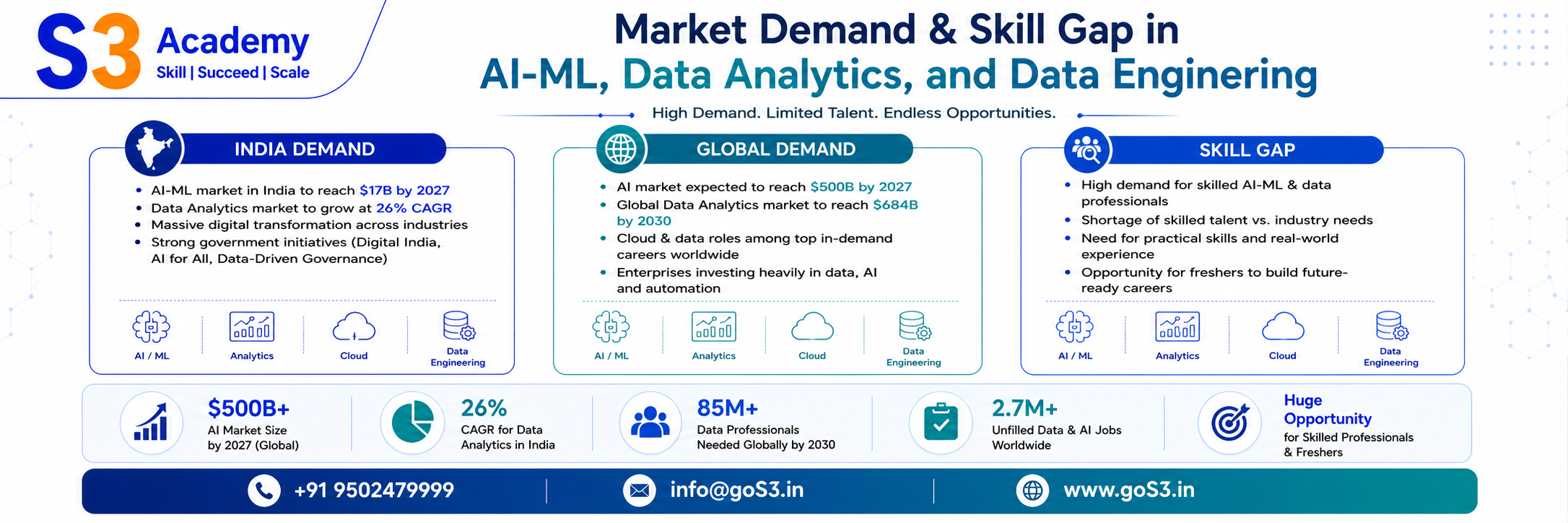
The next five years (2026–2030) represent a golden window for AI, data analytics, and data engineering professionals—particularly in India, which is positioning itself as a global AI talent superpower. However, this opportunity is skill-selective. The market is rewarding specialization in GenAI, modern data infrastructure, and AI-system design while automating away routine tasks.The professionals and organizations that treat continuous upskilling as a core strategy.
Global Market Overview
The AI Economy at ScaleThe global AI market is projected to reach $1.8 trillion by 2030, growing at a 37.3% CAGR. AI is expected to contribute $15.7 trillion to the global economy by 2030 and automate approximately 30% of global work tasks, impacting over 1 billion jobs. However, this automation is creating more specialized roles than it eliminates.
WEF Future of Jobs 2025–2030According to the World Economic Forum’s Future of Jobs Report 2025—based on data from over 1,000 companies across 22 industries and 55 economies:86% of employers expect AI and information processing technologies to transform their business by 203039% of existing skill sets will become outdated between 2025–203063% of employers identify skills gaps as the primary barrier to business transformation85% of employers plan to prioritize workforce upskilling, and 70% expect to hire staff with new skillsThe fastest-growing roles globally include AI and Machine Learning Specialists, Big Data Specialists, Fintech Engineers, and Software Developers.
AI/ML Job Market
Current Trends (2025–2026)
AI/ML roles are experiencing explosive demand:AI, ML, and LLM-driven jobs are expected to grow by 40%+ in 2025 aloneAI-led jobs are forecast to cross 7.8 crore (78 million) globally by 2030In India, roughly 2.9 lakh AI job postings were recorded in 2025, with projections pointing to 3.82 lakh in 2026—a 32% YoY increase
India-Specific AI/ML Landscape
India’s AI economy is forecast to touch $17 billion by 2027, and the Union Budget 2025–26 earmarked ₹2,000 crore specifically for AI infrastructure and research. However, the country faces a critical AI skill deficit of nearly 53%, with NASSCOM estimating India will need close to 1 million AI-skilled professionals by 2027 against a current trained pool of roughly 5–6.5 lakh.
Key hiring sectors in India:BFSI (fraud detection, risk modeling, customer automation)E-commerce and retail (personalization, demand forecasting)IT services and GCCs (building internal AI capability)Healthcare and pharma (AI-assisted diagnostics)
5-Year Projection (2026–2030)Global:
AI/ML specialist roles will remain among the top 3 fastest-growing job categories. The AI software market alone will surpass $800 billion by 2030India: AI-specific hiring is expected to maintain 25–35% annual growth. By 2030, India’s tech workforce is expected to reach 7.5 million, with AI embedded across most tech roles rather than existing as standalone positions.
Agentic AI and multi-agent system design is currently the fastest-growing specialization with a severe talent shortage.
Data Analytics & Visualization Job Market
Current Trends (2025–2026)Data analytics is evolving from descriptive reporting to AI-augmented, predictive, and prescriptive intelligence:The U.S. Bureau of Labor Statistics projects data analytics-related occupations to grow 31% through 203090% of current analytics consumers are expected to become content creators enabled by AI and easy tools by 2026Gartner predicts 75% of businesses will use generative AI to create synthetic data for analytics by 2026
Role Evolution:
The traditional data analyst role is splitting into two tracks:
Analytics Engineers — who manage analytical pipelines, define business logic through code (SQL, dbt, Python), and automate reporting.
AI-Augmented Analysts — who leverage copilot features in Power BI, Tableau, and Looker for natural language querying, auto-generated SQL, and anomaly detection.
Most in-demand skills for data analysts (2026):
SQL — mentioned in 52.9% of job postings
Python — 31.2% of postings
Power BI — 29% of postings
Tableau — 26.2% of postings
R — 24.9% of postings
5-Year Projection (2026–2030)Democratization acceleration: Self-service analytics and no-code/low-code tools will push basic visualization tasks to business users, while analysts focus on complex modeling and data product development.
Predictive & prescriptive dominance: Static dashboards will decline; real-time predictive analytics integrated with ML models will become standard.
Data storytelling premium: As tools automate chart creation, the ability to translate complex findings into strategic narrative will command higher compensation.
Data Engineering Job Market
Current Trends (2025–2026)
Data engineering has emerged as the foundational layer for all AI and analytics initiatives:
The Global Data Engineering Services market is estimated at $105.39 billion in 2026, projected to grow at a CAGR of 15.12% to reach $213 billion by 2031In the US, the average data engineer salary is $135,654 per annum.
India is moving from “data projects” to “data platforms” — enterprises want scalable, governed, AI-ready data ecosystems.
Technology Shift: From ETL to Modern Data Stack
The traditional ETL model is being replaced by the Modern Data Stack (MDS):Cloud storage (S3, ADLS, GCS)Distributed compute (Spark, Databricks)Warehouses (Snowflake, BigQuery, Synapse)Transformation tools (dbt)Orchestration (Airflow, Prefect)
Emerging role: Data Platform Engineer — designing reusable ingestion frameworks, governance layers, and self-service analytics infrastructure.
Regional Demand HubsIndia: Bangalore dominates, but Hyderabad, Pune, and Delhi NCR show strong growth. Tier-2 cities are emerging as GCCs expand analytics hubs beyond metros
Global: London, New York, and Bangalore remain the top three volume markets, with Madrid and European secondary markets rising
5-Year Projection (2026–2030)
Real-time & streaming dominance: Batch ETL will decline; streaming systems (Kafka, Flink) and real-time data pipelines will become standard as AI applications demand instant data.
AI infrastructure convergence: Data engineers will increasingly support ML workflows, requiring skills in feature stores, model data governance, and MLOps.
Data observability explosion: As pipelines grow complex, data quality monitoring and lineage tracking will become dedicated specializations
Leave A Comment